
The Deeply Unreasonable Topology of the Modern Compressed Archive
Unreasonable Logic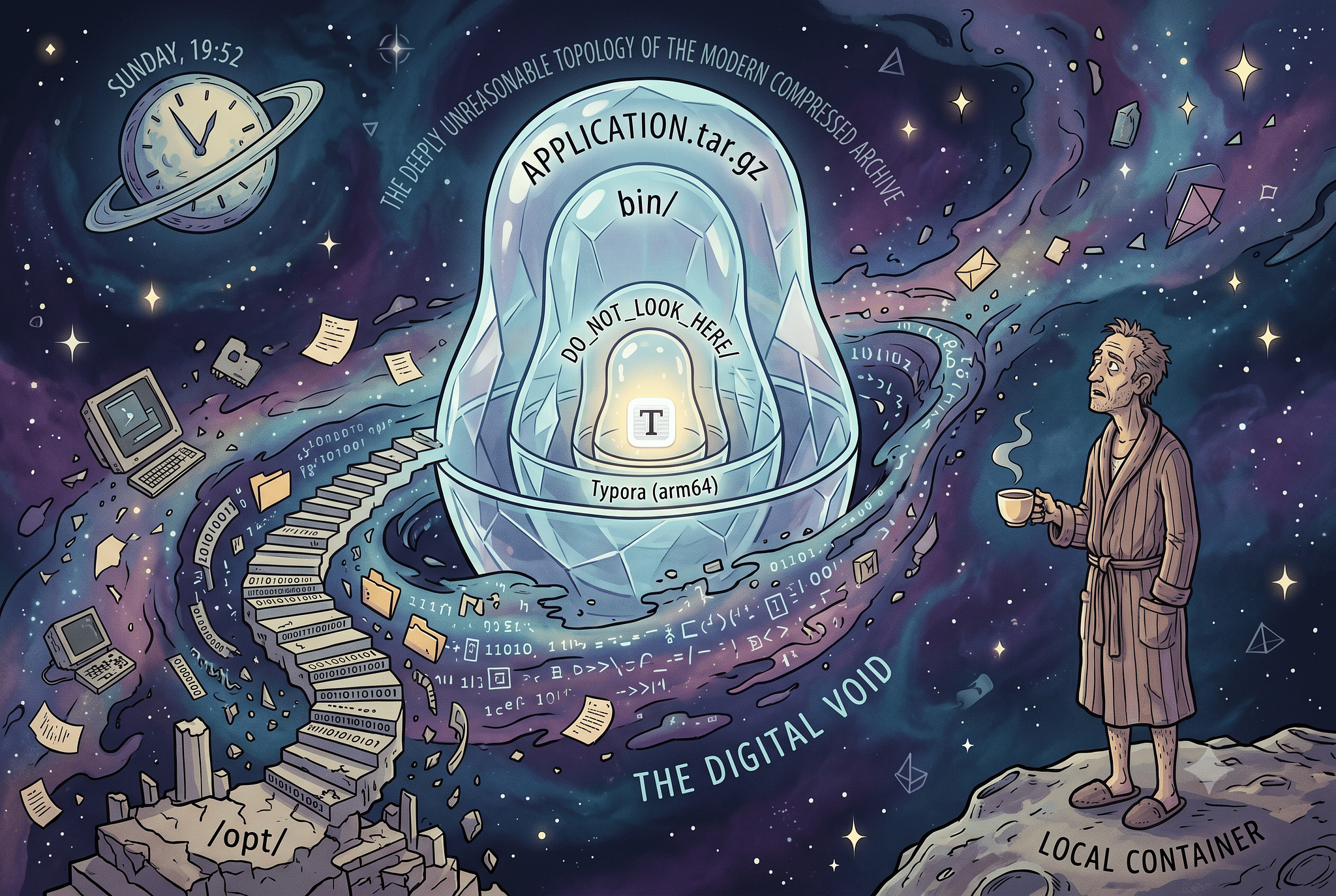
It is a little-known fact, or possibly a widely ignored one, that computers do not actually want you to use them. They would much prefer to be left entirely alone in quiet, sterile rooms, whirring gently to themselves and contemplation of the number forty-two, rather than dealing with the messy business of human thoughts being converted into text.
I discovered this because I decided I wanted to write.
Writing, in its purest form, requires very little: a brain, a finger or two, and a surface that remembers things when you hit it. For centuries, this was a piece of paper. If you wanted to upgrade your paper, you bought a slightly smoother piece of paper. At no point did the paper demand to know if your fingers were built on an ARM64 architecture, nor did it require you to execute a recursive force-delete on the desk it was sitting on.
Enter the Chromebook. A sleek, silent piece of hardware that promises the world but is secretly powered by a tiny, paranoid Linux engine that treats every incoming application like an unexploded bomb.
I wanted a simple Markdown editor. A clean, digital sheet of paper called Typora. I found the file. I checked the architecture. I downloaded it. It arrived as a .tar.gz, which is the computing equivalent of a very tightly packed suitcase wrapped in industrial duct tape.
"Splendid," I thought, with the naive optimism of a man who still believes the universe operates on a system of cause and effect. "I shall simply unpack the suitcase."
I told the terminal to unpack it into a sensible cupboard called /opt/typora. The terminal whirred, looked me dead in the eye, and told me that no such application existed.
-bash: typora: command not found
What followed was an hour of digital archaeology that would have baffled the architects of the Great Pyramid. It turns out that when the suitcase was unpacked, it didn’t just release the editor. No. It created a hidden cupboard inside the suitcase called bin. And inside bin, it built a smaller, more exclusive suitcase called Typora-linux-arm64. And inside that suitcase, buried under a completely irrelevant document warning me not to add files to the place I had just been forced to look, sat the actual application.
It was a software package designed on the principle of the Russian Nesting Doll, constructed by a programmer who had clearly suffered a profound emotional trauma involving a filing cabinet.
The application wasn't broken. It was just hiding. It had constructed a three-tier subterranean bunker inside my own hard drive because it simply couldn't face the psychological pressure of being asked to render a bold font on a Sunday evening.
We found it, of course. We dragged it out of the nested sub-bins, broke down its internal sandboxes, forced it into a logical directory, and slapped a license key onto it before it could find another corridor to run down.
It is now up and running. It looks beautiful. It is completely minimal, clean, and silent. But I can’t shake the feeling that every time I minimise the window, the code is quietly shuffling itself back into a folder called DoNotLookHere_Final_v2_UPDATED.
I need another cup of tea. A proper one. One that doesn't require me to grant superuser permissions to the kettle before it agrees to boil.