
The Three-Body Problem
Unreasonable Logic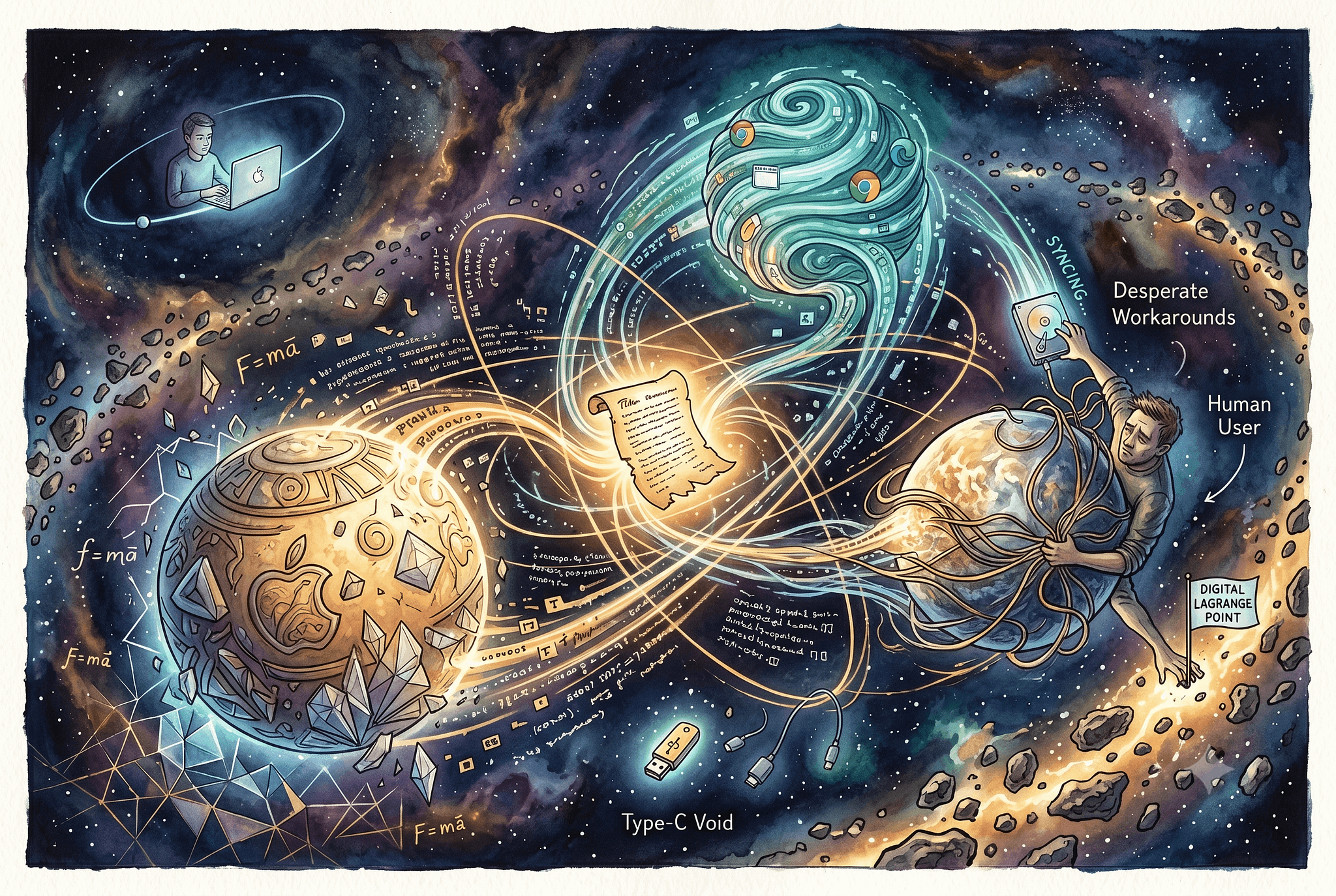
It is a well-known fact that moving data from one computing device to another is very much like attempting to step from one speeding train to another while both are negotiating a tight bend in opposite directions.
It is a perilous manoeuvre, fraught with the kind of risk that usually results in either you arriving on the destination train with your dignity and documents intact, or bouncing merrily along the sleepers with little hope of keeping your luggage together. And some significant abrasions.
We are told we live in a modern golden age of technology where switching between platforms should be easy. And it is—provided you are particularly adept at juggling flaming batons while balancing on one leg on a greasy beach ball.
This is not a new problem. In fact, it is a classic conundrum inherited directly from the world of physics, known simply as the Three-Body Problem.
In 1687, Sir Isaac Newton solved the two-body problem. He proved that if you have just two objects—like the Earth and the Moon, or a solitary Writer and a shiny Apple Laptop—acting on each other through a single field of gravity, the maths is delightfully clean.
You use the laptop; the laptop obeys you. Two bodies. The universe is predictable, the orbits are stable, and your document stays exactly where you left it. The same applies if you happen to orbit a sleek, silent Chromebook.
But the moment a third body enters the system, Sir Isaac’s neat universe completely shatters.
Let us say, in a moment of profound cosmic optimism, you decide to own both an Apple laptop and a Chromebook. You now have three distinct gravitational masses—You, the Apple Ecosystem, and the Google Cloud—all pulling on a single, defenceless document simultaneously.
In 1887, the mathematician Henri Poincaré proved that there is no general algebraic formula to solve this state of affairs. You cannot write a single equation that plugs in time (t) and spits out the exact position of your files for any future date.
Instead of neat, predictable orbits, everything enters the realm of deterministic chaos. Because Google is pulling the file toward the browser, and Apple is pulling it toward the hard drive, the gravitational forces change every time you hit the space bar. The orbits become wildly complex and looping.
A formatting choice made on the Mac causes a violent gravitational slingshot on the Chromebook, hurling your paragraphs into deep space and replacing your bullet points with small, unreadable squares.
Faced with a universe of deterministic chaos, the human user cannot rely on elegant equations. Instead, they must resort to the same desperate workarounds that astrophysicists use to keep satellites from hurtling into the sun.
First, they try Numerical Approximation, otherwise known as the Brute Force Method. In physics, if you can’t predict the future with a formula, you use a computer to calculate the orbits second by agonising second. In the home office, this manifests as the user manually hitting "Save," "Export," and "Sync" every thirty seconds, followed by a frantic dance of checking both screens to see if the changes took. It is a method that merely delays the inevitable meltdown, usually resulting in a hard drive littered with files named Draft_Final_v2_ACTUALLY_FINAL_FOR_CHROMEBOOK.docx.
When that fails, the desperate writer begins hunting for a digital Lagrange Point—those tiny, precarious pockets in space where the gravitational pull of two massive bodies perfectly cancels out, allowing a third small object to hover in a state of fragile equilibrium.
They look for that one mythical software bridge where Apple and Google might coexist in peace.
They try emailing the file to themselves, only for the attachment to be stripped by an overly anxious security filter. They try using a physical USB thumb drive, entirely forgetting that the Chromebook requires a Type-C port and the Mac requires an expensive dongle that is currently down the back of the sofa.
They try pasting the entire text into a bare-bones, formatting-free text file, effectively stripping their creative work down to its bare atomic particles just so it can survive the journey across the void.
Eventually, the laws of thermodynamics and cosmic frustration take over. Just as most chaotic three-body systems end with one object being violently ejected into deep space, the user’s experiment in cross-platform harmony reaches its natural conclusion.
The Chromebook is slammed shut. The Apple laptop is pushed aside. The user sighs, reaches into a drawer, and pulls out a completely stable, non-networked, beautifully predictable two-body system that Sir Isaac Newton would have heartily endorsed: A ballpoint pen and a spiral-bound notebook.
Which, predictably, immediately runs out of ink.