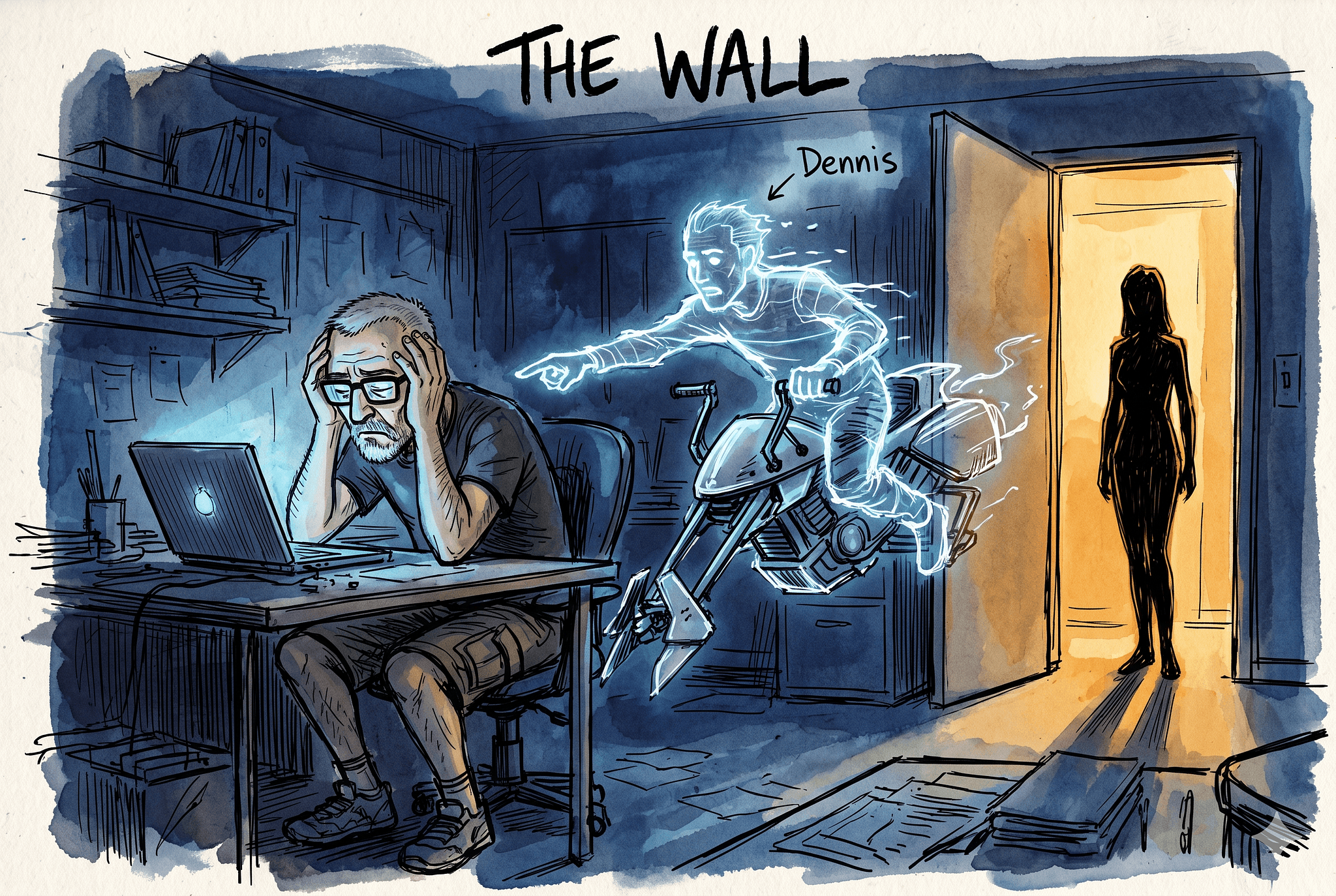
The Wall
Cyberpunk
The rain in Bethnal Green didn’t have the corporate polish of Canary Wharf. It was proper London rain—heavy, grey, and smelling vaguely of damp soot and fried onions. It was the kind of rain that got into your socks and stayed there for three days.
John Mason stood outside an old Victorian warehouse that looked like it had been condemned since the Great Fire. The windows were bricked up, the steel shutters were rusted shut, and the whole place leaned to the left like a drunk looking for a lamp-post.
—Lilli, John muttered, pulling his collar up.
—I’m here. It’s a dump. You sure she’s in there? The Ministry lot said she was under ‘maximum protection.’
—The Ministry are idiots, John, Lilli’s voice crackled.
She sounded stressed, the usual calm Finnish ice in her voice replaced by a jagged edge.
—They let a Yakuza ‘extraction team’ walk right into a government safehouse. I tracked Mouse’s neural signature to this coordinate. It is faint, John. They have her in a Faraday cage. They are trying to scrub her brain for the DataMine codes.
—Right, John said, looking at the massive steel shutter.
It was reinforced with mag-locks. There wasn’t a keypad. There wasn’t a handle. It was just a wall of dead metal.
—How do I get in? You got a back door?
—I have nothing, John. The building is totally dark. No net access, no smart-grid, nothing. It is a black hole.
John looked at the brickwork next to the shutter. The mortar was crumbling, but the bricks were thick, old-fashioned London stocks. He ran a massive, augmented hand over them. He could feel the hum of his own internal power-cell, a low throb in his chest.
—Lilli, John said.
—You remember what I said about physics?
—John, please do not tell me you are going to—
—I’m not going to use the door, Lilli. The door is what they expect. It’s a matter of manners, innit? Don’t want to be predictable.
John stepped back. He adjusted his flat cap. He took a deep breath, feeling the actuators in his legs whine as they drew maximum torque. He didn’t just run; he launched.
Six-foot-eight of mil-spec muscle and chrome hit the brickwork at the equivalent of forty miles an hour.
The sound was like a bomb going off in a library. Bricks didn’t just break; they turned into red dust and shrapnel. John went through the two-foot-thick wall like it was made of wet Ryvita. He landed on the other side in a crouch, surrounded by a cloud of Victorian masonry and white dust.
—John! Lilli shouted.
—Your vitals just spiked into the purple! Are you dead?
—I’m fine-ish, John grunted, standing up and shaking a half-brick off his shoulder.
—But I think I’ve bollocksed another jacket.
The room was a stark contrast to the outside. It was filled with high-end tech, glowing blue monitors, and three men in sharp black suits with chrome-plated katanas strapped to their backs. They were Yakuza ‘Street-Samurai,’ and they looked very, very surprised to see a giant man standing in a hole where a wall used to be.
The first one didn’t even have time to draw his sword. John reached out, grabbed a handful of the man’s expensive suit, and threw him through the other wall, into the next room.
The second one was faster. He drew a smart-pistol, the red targeting laser dotting John’s forehead. John didn’t flinch. He just picked up a heavy wooden packing crate and used it as a shield. The bullets chewed into the wood, but John kept moving. He reached the man, grabbed the pistol, and crushed it—metal, plastic, and sensors—into a ball of scrap. Then he gave the man a gentle tap on the chin. The Yakuza went down like a sack of spuds.
The third one, the leader, drew his katana. The blade hummed with a high-frequency vibration that could cut through tank armour. He moved in a blur of reflex-boosted speed.
—John, watch out!” Lilli yelled. —His blade is—
John didn’t wait for the technical specs. He didn’t try to out-speed the man. He just waited. When the blade swung toward his neck, John stepped in. He took the hit on his shoulder—the reinforced chrome plate shrieked as the blade bit in—but it gave him the opening he needed.
John grabbed the man’s sword-arm. He squeezed. There was a sickening crunch of augmented bone. The katana clattered to the floor. John then picked the man up by his belt and his collar, held him over his head for a second, and slammed him down onto a heavy oak table. The table didn’t survive. Neither did the man’s consciousness.
—All clear, John panted. He looked around. In the corner of the room was a shimmering silver box—the Faraday cage.
He walked over, grabbed the top of the cage, and peeled it back like a tin of sardines. Inside was Mouse. She was curled in a ball, her violet goggles cracked, looking small and terrified.
—Mason? she whispered, squinting at him through the dust.
—You… you came through the wall.
—Door was locked, love, John said, reaching in and lifting her out with one arm.
—You alright?
—I’m… I’m okay. They couldn’t get past my encryption. I just kept thinking about cheeseburgers.
—Good girl, John said.
He looked at the hole he’d made. The rain was drifting in, mixing with the dust.
—John, Lilli’s voice came through.
And for the first time, she sounded like she was laughing. Or at least, as close to laughing as a Finnish hacker gets.
—Yeah?
—I am looking at the structural sensors in the area. You literally moved the building three inches to the left.
—I was in a hurry, wasn’t I?
—I have decided, John. I am changing your handle in my encrypted files.
—Oh yeah? What to? ‘Big John’? ‘The Hackney Hammer’?
—No, Lilli said.
—From now on, you are ‘The Wall.’ Because nothing gets past you, and you do not care what is in your way.
John Mason looked at the wreckage of the warehouse, the unconscious Yakuza, and the tiny, vibrating girl in his arms. He adjusted his cap and started walking back out through the hole he’d made.
—The Wall, John muttered to himself.
—I suppose it’s better than ‘The Wardrobe.’ Come on, Mouse. Let’s go get that cheeseburger.