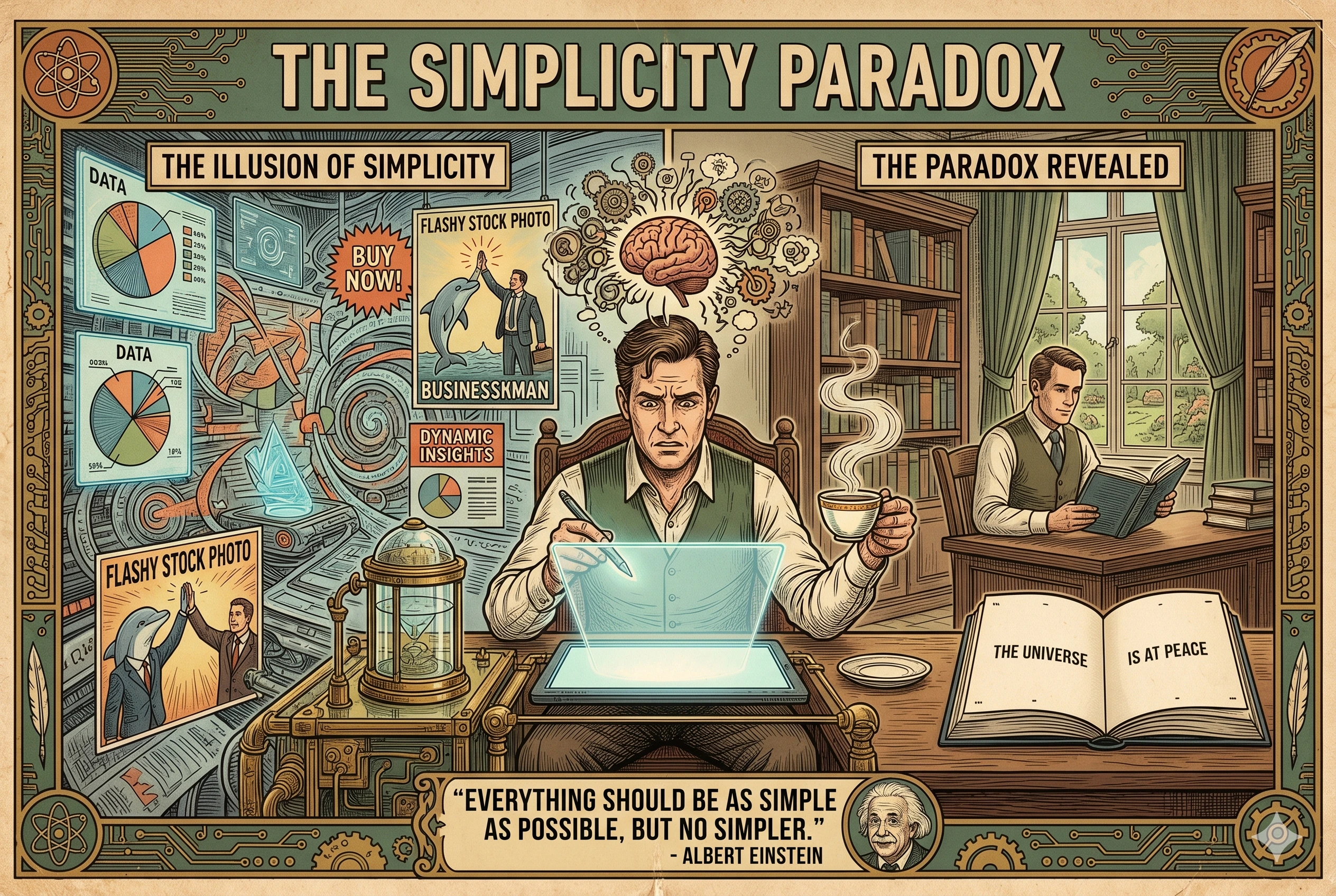
There I sat on a Saturday afternoon, possessing a fresh brew, a blank screen, and a formidable willingness to write.
The primary problem with a willingness to write is that it rarely comes equipped with an instruction manual. Write what? I asked myself.
I considered the blog. The very one currently occupying your photons. I thought about explaining the philosophy behind it. The deliberate, almost heroic decision to keep things plain, readable, and entirely devoid of digital jazz.
No, I thought, don’t do that. That’s just making a loud, unnecessary noise about a quiet space. It’s the equivalent of a man standing in an empty room with a megaphone, shouting about how wonderfully quiet the room is.
But the thought refused to clear its throat and leave. I had foolishly assumed that writing about simplicity would be, well, simple. It isn’t. It turns out that when you strip away the digital architecture of the modern internet, you are left entirely exposed.
When a design is truly minimal, there is absolutely nowhere for a bad sentence to hide. You cannot distract a reader from a deeply flawed argument by throwing a flashy, high-resolution stock photo of a businessman high-fiving a dolphin at them. You can’t mask a weak point with a dynamic, spinning pie chart. The words are forced to stand there on their own, shivering in the cold light of the user’s gaze.
It is one of the universe’s more irritating ironies that the concept of simplicity becomes infinitely more complex the more you think about it. Simple writing actually demands a terrifyingly high bar of clarity, rhythm, and precision. It forces the writer into a state of aggressive, almost bureaucratic self-editing.
From the reader’s perspective, of course, a text-focused layout is an absolute triumph of thermodynamics. It drastically reduces cognitive load. There are no flashing ads trying to sell you insurance you don’t need, no “read next” popups leaping out like aggressive street corner vendors, and no dynamic widgets fighting a losing battle for your dwindling attention span.
That was the realisation that finally landed. When you open an article here, it should feel remarkably like opening a physical book—an ancient, carbon-based technology that modern civilisation spent billions of pounds trying to replace, only to realise it was perfect in the first place. The background is a comforting warm white, the text is dark, and the margins are wide enough to breathe in. You read. You think. And when you finish, you simply close the tab.
That is the entire experience. The universe, for a brief moment, is at peace.
But of course, my mind complained that at least there should be illustration. Because without it, sharing the post would be like trying to use a bus ticket from fifty years ago to travel on a service today. Sharing writing needs something to look at.
I sighed with the sinking feeling that I could almost achieve the simplistic approach I wanted. But a chap called Einstein nailed it for me. He said:
Everything should be as simple as possible, but no simpler.
Indeed, Albert.
I looked down, discovered that my brew had succumbed to the laws of entropy and gone cold, and deeply considered the logistics of making a new one. The afternoon had successfully negotiated its way into becoming evening. But at least the article was done.