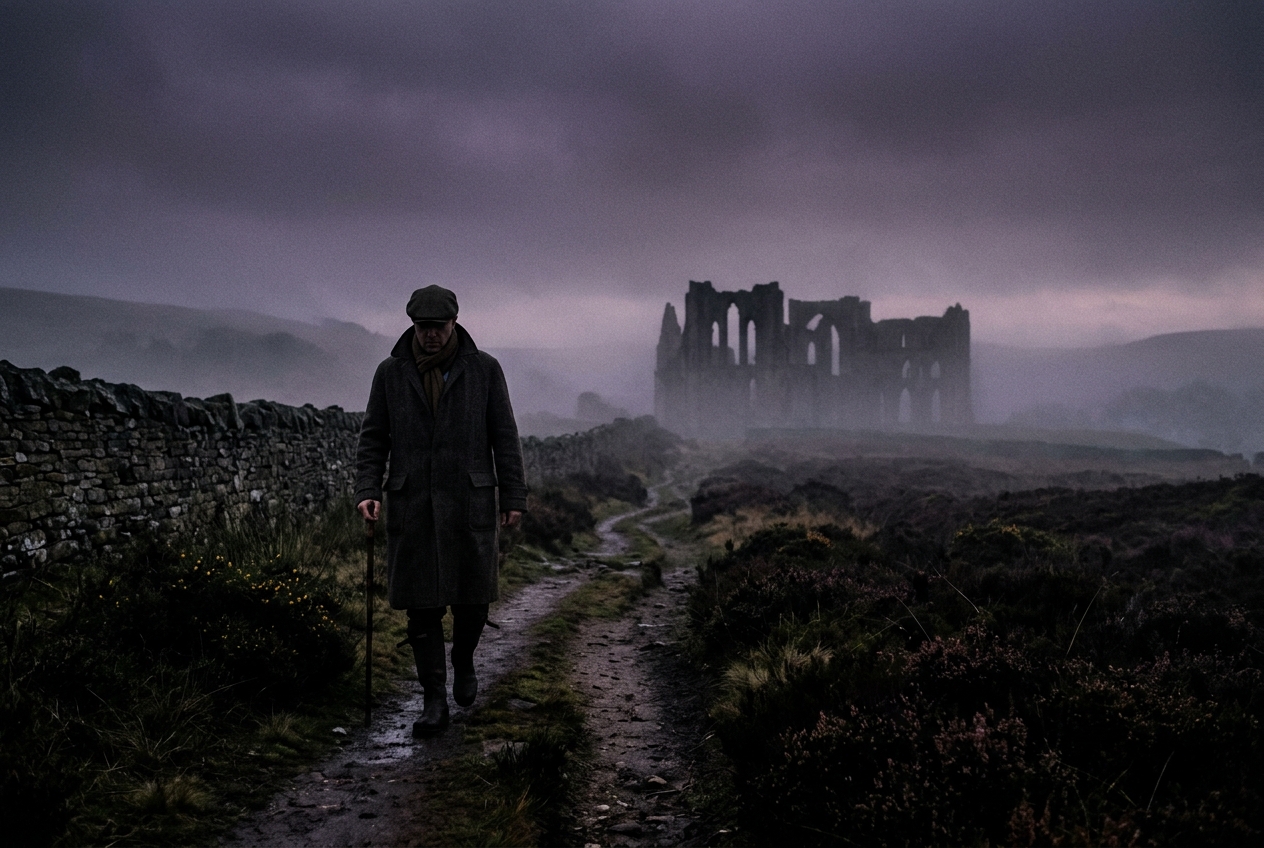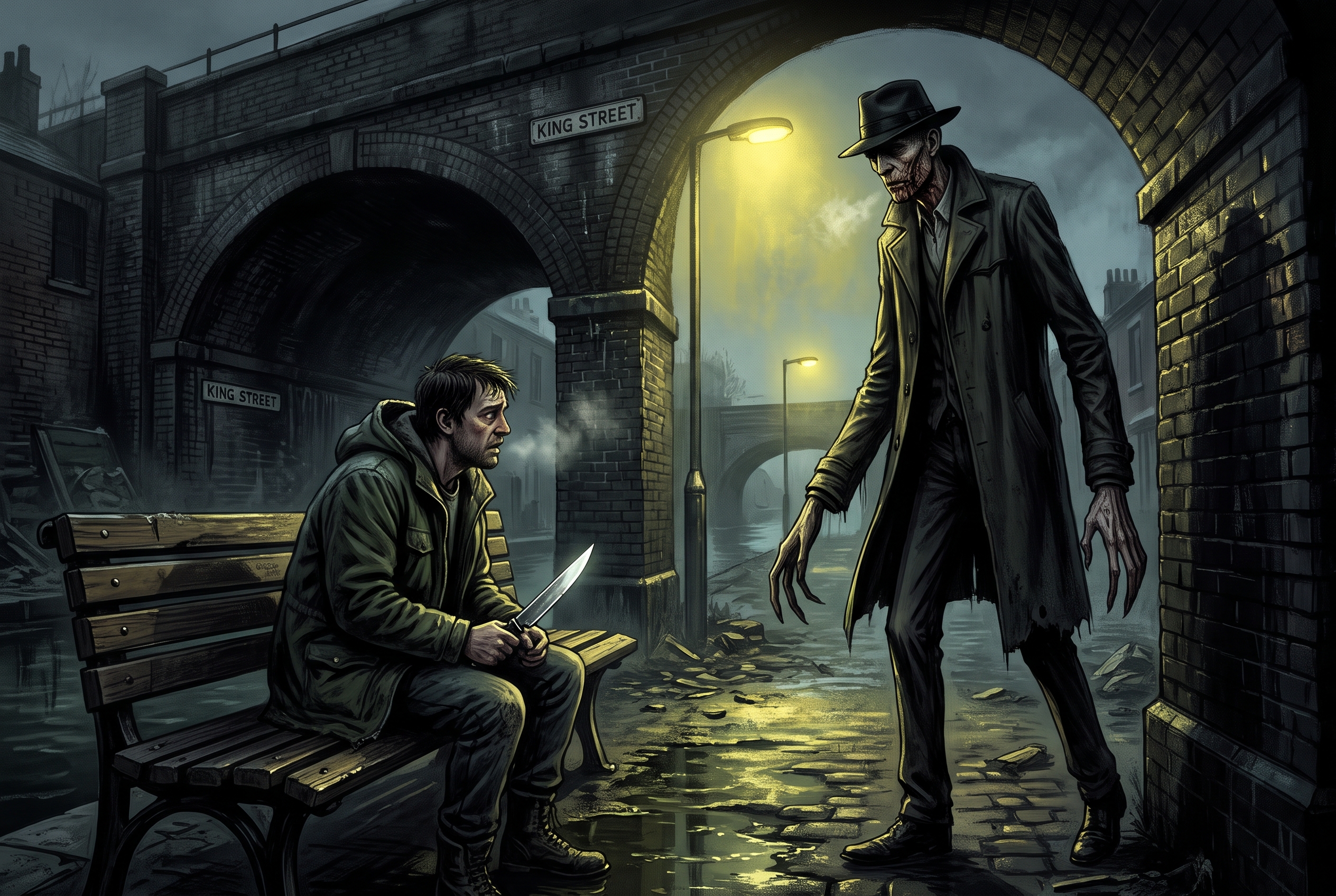
The old Grimsditch canal slid beneath the railway arch on King Street like black grease.
Noah Peters walked slow. Shuffling. He had nowhere to be, and he was in no hurry to arrive.
He patted the pockets of his parka. Found ‘em. A battered packet of fags and a disposable lighter. He dragged a cigarette out with his teeth, struck the wheel, and inhaled like it was his last.
—Fuckin’ might be. I’m skint.
He dropped onto the wood-slat bench under the arch. The grey daylight made his eyeballs ache. Molly had left him last night. Or he’d left her. The edges were blurry. She called him useless. He called her a bitch. Next thing, she screamed at him to get out. He did. With fuck all except the clothes on his back.
—Ah, be honest, mate, he muttered to the canal.
His brain replayed the reel. After Molly started on him, something snapped. A dry, distinct crack behind his temple, like trodden kindling. He’d stood up, gripped the heavy ceramic vase her mother bought her, and gave her the good news.
A lucky shot. Or unlucky, if you were Molly. Caught her clean across the temple with a dull thunk. She went down sideways, temple clipping the sharp brass corner of the coffee table. The skin split. A dark jet pumped across the rug. She slumped into the corner, neck bent at an unnatural crook.
Noah had stood there for two minutes, listening to the fridge hum. Then he set the vase down, grabbed the carving knife off the draining board, shoved his arms into his parka, and walked out.
—Yeah. That’s more like it.
He sat blowing smoke rings into the brickwork, watching them unravel.
—Enjoyed that, did you?
Noah flinched, smoke catching in his throat.
A man stood five paces away, half in the shadow of the damp brick pier. He was tall. Tall beyond normal for a person. His arms hung down past his hips, far longer than a normal bloke’s. He wore a dark felt fedora pulled low and a threadbare trench coat that fell nearly to his boots.
—Enjoyed what? Me smoke?
—The slaughter, Noah. You took her life, didn’t you?
—How the fuck—
—I know things. Don’t fret.
The man stepped into the sodium wash. Noah recoiled. The skin around the man’s mouth and jaw had crosshatches with weeping, blackened lesions.
—Jesus! What happened to your face?
—Never mind my face. You need to listen.
Noah went to tell him where to shove it, but his tongue felt like a dry sponge. The spit wouldn’t come.
—This here? Under this arch? This is our sanctuary, Noah. Yours and mine. They can’t reach us here.
—Who?
—Those who would see us put down.
—Put down for what?
Noah tried not to ask thick questions, but his skull was empty.
—I call it vengeance on the living, Noah. A settlement with those who think ill of us.
The man’s voice was smooth, flat, and light. It sounded like madness, yet it fitted into the damp air like a key.
—Do you have the blade, Noah? The Sheffield steel you lifted off the counter? I reckon you do.
Noah’s hand moved on its own. He reached into the inner lining of his parka and hauled out the ten-inch carving knife. The edge caught the dirty water’s glare.
—There it is. Good lad.
—I dunno why I picked it up—
—Yes, you do, Noah.
—I bloody don’t! I’m in enough trouble as it is.
—No trouble at all, Noah. Not now. I’m here to take the sting out of it.
The tall man closed the distance. The air went frigid. With it came a stench that turned Noah’s gut—scorched iron, stagnant mud, and cold, curdled grease.
—You want my help, don’t you, Noah?
—Nah, mate. Too weird. I reckon you should toddle off—
—I won’t.
—Why?
—Because you need me. I can take the ache away.
—What ache? I’m not hurting—
—You put her down, Noah. And it felt righteous. Admit it. You felt weightless after, didn’t you?
—No. I felt sick.
—I think not.
Noah squinted under the hat’s brim. The man’s eyes weren’t brown or blue; they were flat discs of wet tar.
—Look, mate. Leave it out. On your way.
—You asked for this, Noah.
—Bollocks. I didn’t say a word—
—That thought you carried across the bridge? Tying something iron to your belt and rolling into the lock? A terrible waste of flesh.
Noah’s ribs went hollow.
—How the hell—
—I told you. I know the books.
—Well, good for you, mate. But you can sod right off.
The stranger didn’t take a stride; he arrived. A blur of black wool that Noah’s eyes couldn’t track.
The kitchen knife was, in an instant, in the tall man’s long, grey fingers. Noah hadn’t felt his own grip loosen.
—Oi! Give that—
—I require the iron, Noah. Since you lacked the stomach to use it.
The tall man moved again. With a sickening, silent flick of the wrist.
The Sheffield blade opened a clean four-inch slit along the anterior border of Noah’s neck, right against the muscle. For a second, the edges pulled wide, pale, and dry.
Then the breach erupted.
A heavy, arterial pulse painted the soot-blackened brick behind the bench. Before Noah could scream, the tall man clamped his mouth over the rupture.
The wet suction was deafening. Noah’s neck ballooned into a tight, purplish hematoma, the skin stretching hot, taut, and distorted beneath the man’s jaw. Noah’s limbs turned to wet sand. The man had him pinned flat against the timber slats, heavy as an engine block.
The world began to grey out at the edges.
The stranger pulled back with a wet pop, one gnarled, lesion-covered hand clamping the spurting hole shut.
—Now, Noah. As dry as I am, we can settle on an exchange, if you have the appetite.
—Wha’…? Noah gasped, his chin wet with his own heat.
—You are five minutes from the gutter. But I can tip my own black into your veins. You’ll rise like me.
Noah looked at the long, spider-thin fingers. At the rotting cheekbones. At the dead eyes.
—No…
—Are you certain? I will drain the last cup, Noah. You will get your quiet water, but it won’t be in the canal.
—Be… like you? No. Fuck off.
The man’s mouth twitched into a thin, cold crescent.
—Fair enough, Noah. You had the offer.
The tall man leaned his weight back down, opened his jaws, and went back to work.