The house cost forty-two grand at auction because nobody wanted a top-floor flat where the roof leaked and the plaster smelled of wet copper.
Elias took it because it was cheap, and because after thirty years on the tools, he didn’t fancy arguing with a landlord. It was quiet. Not peaceful quiet—the heavy, woollen silence of old lime plaster and floorboards that didn’t settle right.
He told his pal Aisling about the place.
—Wha? That place? I wouldn’t move there, mate.
—Why?
—It’s a shit hole, that’s why.
—It’s a cheap shit hole.
She rolled her eyes and nodded. So he moved in.
The hum started on a Thursday.
It wasn’t a noise in the ear. It sat lower. Down in the teeth and the marrow of his collarbones, like an idling diesel lorry parked three streets off that refused to pull away. Elias sat on the edge of the mattress, tea mug in both hands. He pressed his palm against the wallpaper—faded yellow roses peeling back from damp scrim.
Nothing. Just the draught off the sash window.
—Dodgy immersion heater, he muttered.
He went down to the cupboard under the stairs. Flipped the master breaker. The flat went black The fridge stopped rattling. The hum stayed. Steady. Cold. Vibrating through the soles of his slippers.
By Saturday, the hiss came in.
He phoned Aisling.
—Alright, mate? How’s the new gaff?
—Er, not bad. Makes funny noises, though.
—I ain’t surprised. Place will fall down soon enough.
She chuckled. Elias didn’t.
The hum kept going. It wasn’t words. It was the dry, sibilant drag of an old radio tuner dragged across dead bands—a scratchy, mechanical scrape from behind the skirting board. It had a rhythm. Three short bursts, a long dragging scrape, then dead silence that made his ears ring until his skull throbbed.
He didn’t sleep. He sat at the kitchen table with an old handheld tape recorder he’d lifted from the lock-up. He hit record, set the plastic casing flat against the baseboard, and boiled the kettle.
When he played the tape back, his skin prickled.
The microphone hadn’t caught the kettle whistling. It hadn’t caught his breathing. It had caught a sequence of hard, dry clicks—deliberate as a telegraph wire.
He rewound it. Pressed the speaker to his ear.
The clicks shifted pitch. They weren’t random interference. They were consonants. Flattened, metallic, stretched out like wire through a die, but carrying the unmistakable cadence of an address.
—Still here— the tape seemed to wheeze through the hiss.
The temperature in the kitchen plummeted. The steam coming off the spout of the kettle turned to white frost on the windowpane.
Elias set the recorder down. The plastic felt like ice straight out of the freezer.
—Right, he said aloud, his voice sounding flat, tiny, swallowed up by the lino. —Blocked pipes. I’ll call the council Monday.
He walked into the hallway to fetch his coat. He’d go for a pint. Meet Aisling.
He stopped by the turn in the stairs.
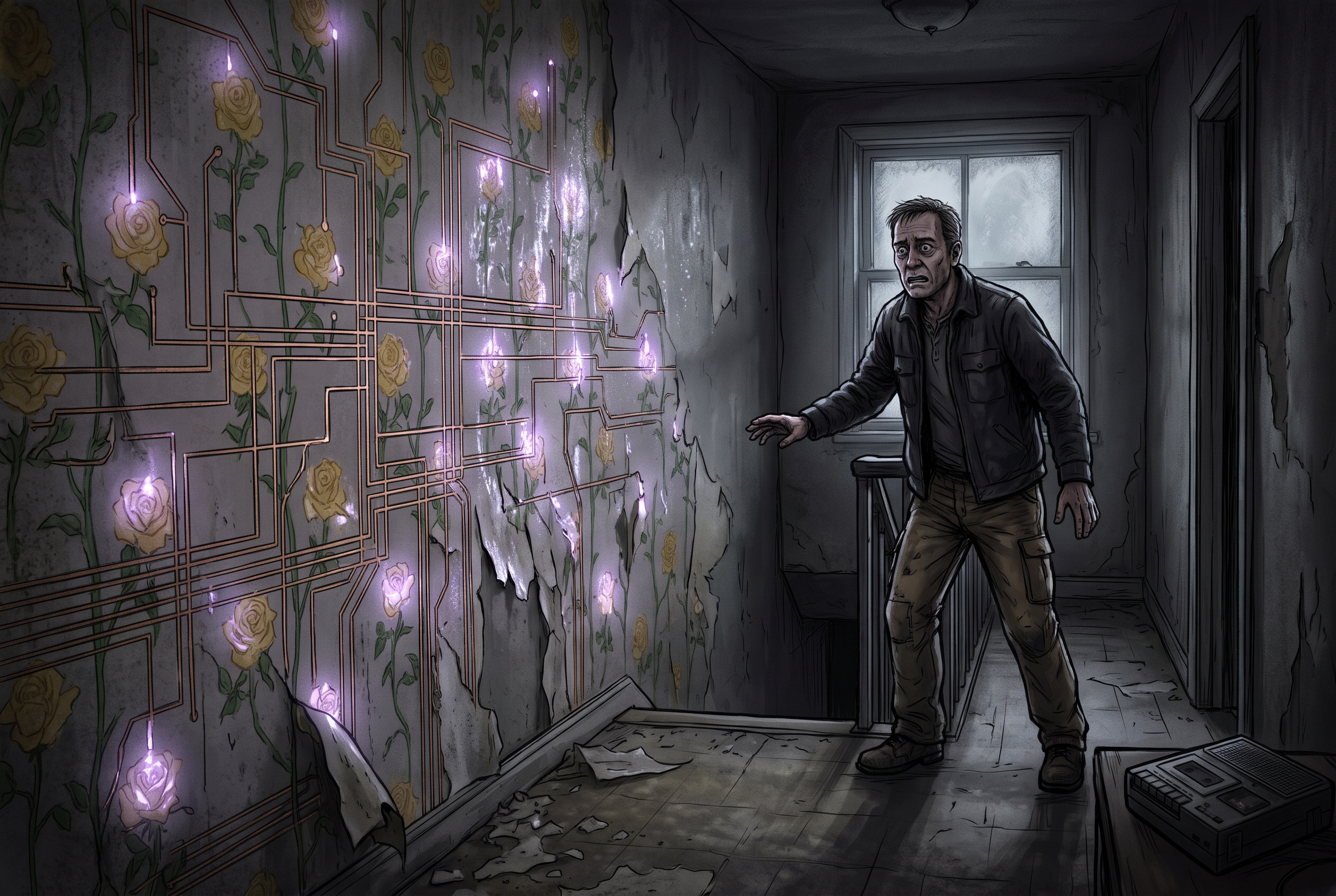
The yellow roses on the wall weren’t roses anymore. The pattern had tightened. The printed green stems had straightened into hairline copper tracks. Interlocking at sharp, impossible right angles that made his eyeballs ache if he looked straight at them. The faded blooms were pulsing—tiny, rhythmic blinks of pale violet light, tracking down the wall toward the floorboards.
Not decoration. A grid.
He reached out a thumb to touch the paper. He couldn’t lift his arm. The hum in the floorboards dropped three octaves, hitting him in the chest like an electric shock. His jaw clamped shut. His tongue tasted of crushed iron and wet pennies.
The wall wasn’t solid brick. In the gaps between the printed circuits, the plaster was thin as tissue. Looking out into a vast, light-less grey space where something massive, cold, and indifferent was processing data. It wasn’t angry. It was just listening.
And now it had a signal.
Elias tried to drag air into his lungs, but his throat was full of dry, sibilant static. The yellow roses flickered once. The circuit snapped closed. And in the silence that followed, Elias didn’t even leave a draught behind.